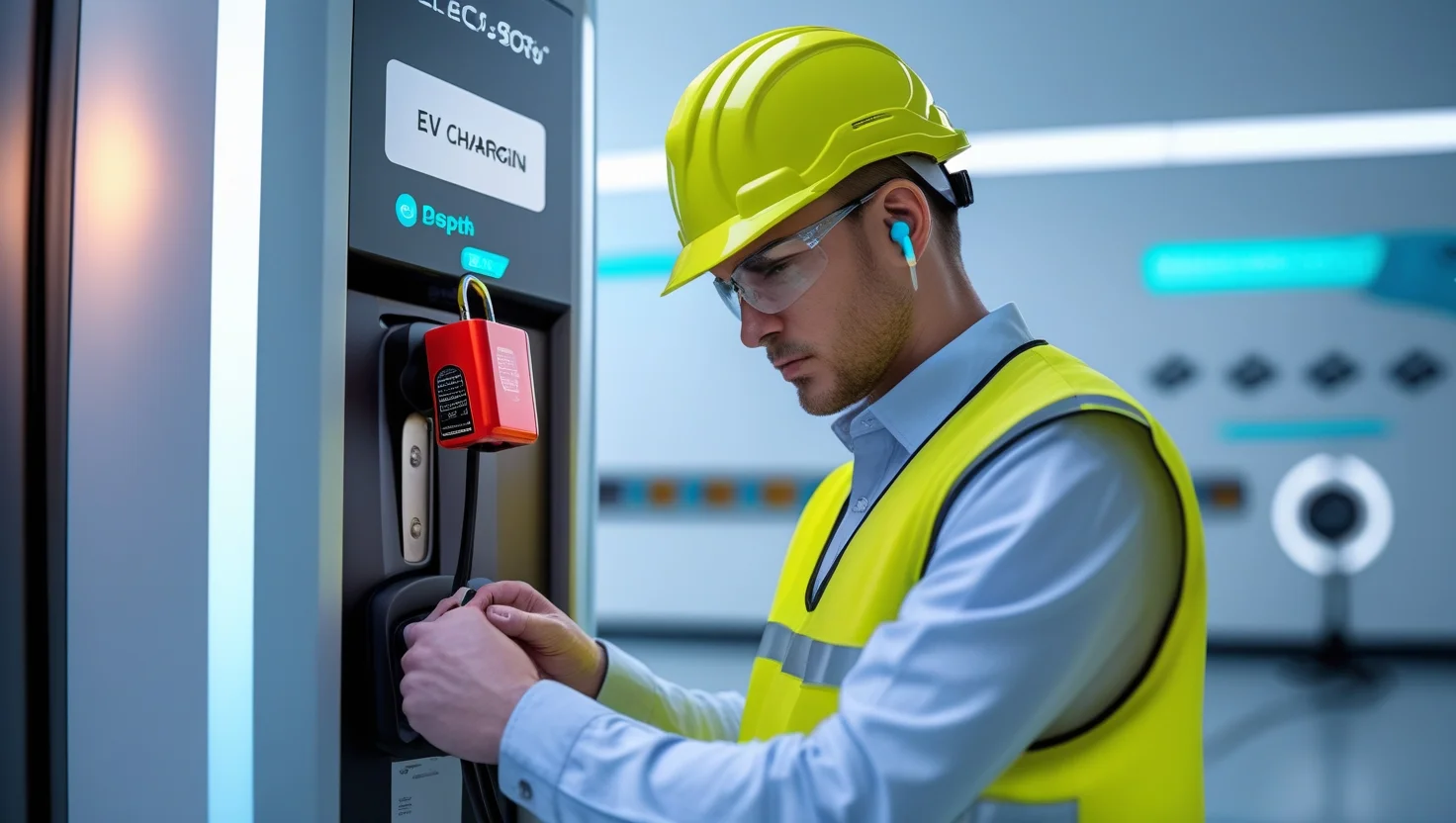
🔍 Introduction: Why EV Charging Station Lockout/Tagout Is Critical in 2025
With electric vehicles (EVs) becoming increasingly popular in the US, UK, and Canada, the need for a dependable and secure EV charging station network has never been more important. As this infrastructure expands, so does the responsibility to ensure safety during servicing and maintenance.
Every EV charging station handles high-voltage electricity, which poses serious hazards if not properly shut down. Improper energy isolation during maintenance can result in electric shock, equipment damage, or even life-threatening accidents.
That’s why Lockout/Tagout (LOTO) procedures are vital. These safety steps are more than recommendations—they are mandatory under regulations such as OSHA in the US, HSE in the UK, and CSA in Canada.
This 2025 guide walks you through a dedicated 7-step process for safely servicing any EV charging station, helping technicians stay compliant, reduce risk, and maintain reliable charging operations across all environments.
Table of Contents
🛠 7-Step EV Charging Station Lockout/Tagout Safety Procedure
🔌 Step 1: Identify Every Energy Source in the EV Charging Station

Before you begin any repair or maintenance, it’s critical to locate all potential power sources connected to the EV charging station. Failing to isolate hidden energy inputs can lead to serious electric shock or equipment failure.
Key sources to check include:
- AC or DC supply lines from the utility grid or solar panels
- On-site battery storage units used as backup
- Internal capacitors housed inside the charging unit
- Nearby breaker panels or external fuse boxes connected to the station
📍 Use updated electrical schematics or smart maintenance software to trace all energy pathways. Clearly tag each identified source with visible labels to prevent accidental reconnection.
✅ Pro Tip: Reference the facility’s one-line electrical diagram and consult with an electrical engineer for confirmation—especially in large installations.
📣 Step 2: Notify Everyone Affected by EV Charging Station Shutdown

Clear communication is a critical safety step. Before powering down any EV charging station, inform all relevant individuals who may interact with the equipment.
This includes:
- Technical teams and maintenance personnel
- Security guards at public or retail charging stations
- EV users who may attempt to plug in while the station is offline
Use a mix of alerts:
- Post “Charging Station Out of Service” signs visibly on the unit
- Apply caution tape or safety cones around the work area
- Send real-time alerts via internal comms tools or radios if applicable
🚨 Why it matters: Many EV-related service accidents happen when someone unknowingly reactivates a station during repair.
🛑 Step 3: Shut Down the EV Charging Station Completely

After notifying personnel, initiate a complete shutdown of the EV charging station to eliminate live current.
Here’s how:
- Power off the charger via the built-in interface or software panel
- Disconnect it from the main electrical breaker
- Wait until all indicator lights or displays turn off completely
⚠️ Some components retain power briefly. Let the system sit for 30 to 60 seconds after disconnection to allow any residual voltage to dissipate.
📘 Note: Some models require entering a digital PIN or following a software shutdown sequence. Always follow the OEM manual for safe shutdown procedures.
🔐 Step 4: Apply Lockout/Tagout Devices to the EV Charging Station

With power off, physically secure the EV charging station using proper lockout/tagout equipment to prevent reactivation.
What to do:
- Use approved padlocks and hasps to secure breakers or disconnects
- Attach tagout labels displaying technician info, date, and purpose
- If multiple workers are involved, apply a group lockbox system to manage access
🛡 Lockout/tagout creates a visible safety barrier that ensures no one can mistakenly restore power while work is ongoing.
🧰 Team Tip: Set up a central LOTO station on-site to manage tools and keys, especially on multi-charger installations.
🧪 Step 5: Test the EV Charging Station for Zero Energy

Never assume the system is safe after disconnection—always verify that there is no residual energy present in the EV charging station.
Steps to follow:
- Use a CAT III or CAT IV-rated voltage tester
- Measure voltage at fuses, terminals, capacitors, and live conductors
- If voltage is detected, wait longer or discharge manually using appropriate tools
- Wear full PPE, including arc-rated gloves, goggles, and flame-resistant clothing
📝 Record voltage readings in your maintenance log for compliance and accountability.
🔍 Best Practice: Include pre- and post-test voltage readings in service reports for regulatory documentation.
🔧 Step 6: Perform Maintenance Safely on the EV Charging Station

With the system confirmed de-energized, it’s safe to begin maintenance on the EV charging station.
Typical tasks may include:
- Replacing internal fuses, circuit boards, or wiring
- Performing firmware or software updates
- Cleaning debris, oxidation, or corrosion from sensitive terminals
- Inspecting for wear and tear on power connectors or plug cables
🧰 Always use insulated tools and follow standard safety protocols (SOPs). Keep communication open with your team using hand signals, radios, or safety flags.
✅ Pro Safety Tip: Assign a supervisor to oversee the procedure, especially for complex or multi-charger systems.
✅ Step 7: Restore Power and Safely Remove LOTO Devices

After completing your maintenance tasks:
- Clear tools and materials from the workspace
- Reattach all covers, locks, and safety interlocks
- Only the technician who placed the lock should remove the LOTO device
- Notify all impacted personnel that the EV charging station is being re-energized
- Gradually restore power and watch for normal operation signals (LEDs, dashboard)
🧪 Run a final test to confirm functionality before allowing public or fleet use of the charging station.
🔁 Verification Tip: Use diagnostic tools to run a charging test with a dummy load or vehicle to confirm everything is functioning safely.
🌍 Country-Specific Compliance Guidelines (US, UK, Canada)

Lockout/Tagout (LOTO) compliance isn’t just good practice—it’s a legal necessity when working on any EV charging station. Failing to follow required energy isolation protocols can lead to severe penalties, injuries, or even fatalities. Different Tier 1 countries have strict LOTO standards in place to protect both technicians and the public.
Here’s a country-by-country breakdown of what’s expected:
🇺🇸 United States — OSHA & NFPA Regulations
In the United States, the Occupational Safety and Health Administration (OSHA) enforces LOTO through 29 CFR 1910.147, which specifically applies to hazardous energy control, including during EV charging station servicing. Compliance with NFPA 70E is also essential for electrical safety in the workplace.
Key requirements include:
- Documented lockout/tagout procedures
- Proper lockout devices and labels
- Regular technician safety training
- Compliance with NFPA 70E for electrical safety standards
⚠️ Non-compliance can result in federal fines, legal action, or workplace shutdowns.
🇬🇧 United Kingdom — HSE Electrical Isolation Standards
In the UK, Health and Safety Executive (HSE) governs energy isolation under the Electricity at Work Regulations 1989. Any maintenance on an EV charging station must follow strict electrical isolation and control practices.
What’s required:
- Full isolation of electrical energy before maintenance
- Safe work practices supported by risk assessments
- Lockout/tagout devices preventing power reactivation
- Evidence of technician training and procedural audits
🚫 Breaches can lead to criminal prosecution or regulatory enforcement notices.
🇨🇦 Canada — CSA Z460-20 National Standards
In Canada, the Canadian Standards Association (CSA) developed Z460-20, which sets national requirements for LOTO safety—especially for EV charging station servicing and maintenance.
Core mandates include:
- Written lockout/tagout policies for all high-voltage work
- Technician certifications and scheduled training refreshers
- Use of standardized LOTO hardware
- Detailed service logs and inspection records
✅ Provinces and territories across Canada recognize CSA Z460-20 as the benchmark for workplace safety.
💡 Digital Tip: Simplify EV Charging Station Compliance with LOTO Software
Managing compliance across multiple EV charging station locations can be challenging. To reduce errors and streamline audits, many organizations now use cloud-based lockout/tagout management tools.
Benefits include:
- Real-time access to isolation procedures
- Centralized technician credentials and training logs
- Instant reporting and digital audit trails
- Maintenance reminders and compliance checklists
📲 Embracing digital tools helps ensure consistent LOTO practices and regulatory compliance across the board.
⚙️ Pro-Level EV Charging Station Safety Tips for 2025
Elevate your safety protocols with these expert strategies:
- 🔋 Use EV-specific lockout/tagout kits rated for high-voltage equipment
- 📅 Conduct quarterly LOTO training and simulations
- 🏷 Implement QR-tag labels for real-time equipment status tracking
- 🚐 Keep laminated checklists in all service vehicles
- 📸 Take before/after photos to document compliance for audits
These practices not only boost safety but also enhance team accountability.
🧠 Final Thought & Conclusion

As EV charging infrastructure continues to expand across North America and the UK, technician safety must evolve alongside the technology. High-voltage systems demand more than just technical knowledge—they require a culture of proactive safety, accountability, and compliance.
The 7-step EV charging station lockout/tagout procedure outlined in this guide isn’t just a checklist—it’s a life-saving protocol. Whether you’re servicing a home unit, a commercial charger, or an entire fleet, implementing these steps ensures zero-energy conditions, protects your workforce, and maintains the integrity of your equipment.
In 2025 and beyond, EV technicians, electricians, and site managers who follow verified safety protocols will be the ones leading the charge—safely and legally.
🔐 Remember: Real safety starts before the first tool is picked up—and doesn’t end until the system is fully restored and tested.
📣 Final CTA: Stay OSHA-Compliant With EVRescueHub.com

🛡 Whether you’re maintaining one charger or an entire EV fleet, LOTO compliance can’t be ignored.
At EVRescueHub.com, we offer:
- EV-specific lockout/tagout safety kits
- Printable OSHA/HSE/CSA checklists and compliance tags
- Technician training guides and log templates
- Cloud tools for real-time tracking and digital records
👉 Visit EVRescueHub.com today and upgrade your EV maintenance safety—before the next job begins.
📚 Frequently Asked Questions (FAQs)
Q1. What is EV charging station lockout/tagout?
A: It’s a step-by-step safety procedure to disconnect and secure all energy sources during EV charger maintenance to prevent accidents or shock.
Q2. Is lockout/tagout mandatory for EV stations?
A: Yes. OSHA (US), HSE (UK), and CSA (Canada) require it for all high-voltage systems, including Level 2 and Level 3 chargers.
Q3. Should home EV chargers be locked out during service?
A: Absolutely. Residential chargers can still pose serious electrical risks. Always isolate power before opening the unit.
Q4. Are digital-only lockout systems compliant?
A: No. Physical lockout/tagout devices are required. Digital tools help with tracking but can’t replace padlocks and tags.
Q5. What happens if you skip lockout/tagout procedures?
A: Risks include:
- Electrocution or arc flash injuries
- OSHA/HSE/CSA violations and heavy fines
- Voided insurance claims
- Expensive equipment failure or fire
🔗 Follow Us & Share the Mission:

🌐 Website: EVRescueHub.com
📺 YouTube: youtube.com/@EVRescueHub – Watch our latest EV safety shorts & tutorials
📘 Facebook: facebook.com/EVRescueHub – Join the discussion & share safety updates
🐦 Twitter/X: twitter.com/EVRescueHub – Get real-time alerts & fire incident updates
📸 Instagram: instagram.com/EVRescueHub – Follow for behind-the-scenes rescue tips & reels
📢 Telegram Channel: t.me/EVRescueHub – Instant tips, recall alerts & community questions